
Roof Insurance Claims in Texas: The Complete Guide
A roof insurance claim in Texas works like this: a hailstorm or wind event damages your roof, you document the damage and get a free professional inspection with dated photos before the adjuster visits, you file the claim, the adjuster inspects, and the insurer pays the replacement cost minus your deductible — first as actual cash value, then as recoverable depreciation once the work is done. Your deductible is a percentage of your home’s Coverage A limit, usually 1% or 2%, and no roofer can legally waive it, rebate it, or absorb it. That last point is Texas law, HB 2102, and it is the most important thing on this page. Everything else is process. That part is the law. This is the roof insurance claim process Texas homeowners face after hail or wind — and the same process decides whether your roof is repaired or replaced.

The deductible: the math that surprises everyone
In Texas, your roof deductible is usually a percentage of your Coverage A limit — the dwelling coverage amount on your policy — not a flat dollar figure. Many homeowners do not realise this until after a storm, and the number is often larger than they expected. That percentage is the first number to check before filing a roof insurance claim Texas — it decides whether the claim is worth more than what you pay out of pocket.
| Coverage A | 1% deductible | 2% deductible | 5% deductible |
|---|---|---|---|
| $200,000 | $2,000 | $4,000 | $10,000 |
| $300,000 | $3,000 | $6,000 | $15,000 |
| $400,000 | $4,000 | $8,000 | $20,000 |
| $500,000 | $5,000 | $10,000 | $25,000 |
Most Lubbock policies now carry a 1% or 2% wind/hail deductible, and many insurers are moving customers from 1% to 2% at renewal. Some policies go up to 5%, and a few higher. Check your declarations page — the deductible is printed there, and it is worth knowing before a storm, not after. A roof insurance claim Texas homeowners file starts with that number. Most Texas roof insurance claims turn on the same two numbers — your deductible and the RCV of the roof — so know both before the adjuster arrives.
HB 2102: the deductible law, in plain English
Texas House Bill 2102 took effect on September 1, 2019. Under Texas HB 2102, it is a crime for a contractor to waive or absorb your deductible, and a crime for the homeowner to knowingly accept it — a Class B misdemeanor, up to a $2,000 fine and up to 6 months in jail. It also gives the insurer grounds to deny the claim entirely.
Every roof insurance claim Texas homeowners file is governed by this law — it is the first thing to understand before you file, and the reason no honest roofer will ever offer to cover your deductible. That is why every roof insurance claim Texas homeowners file starts with the same advice: document first, call second.
What that means in practice: “free roof” is not a real offer. If a roofer says your roof will cost you nothing, they are either planning to break the law or planning to inflate the claim to cover your deductible — which is insurance fraud. “We will cover your deductible” is illegal, as is any rebate or “free gutters to cover it” arrangement. The honest version is simple: you pay your deductible, the insurer pays the rest, and the roofer does the work for the agreed price.
Three more things worth knowing about the same law. First, your insurer can ask for reasonable proof that you paid your deductible before it releases the recoverable depreciation (§707.005) — keep the receipt. Second, any roofing contract over $1,000 that will be paid from claim proceeds must carry a written notice, in at least 12-point bold type, stating that Texas law requires you to pay your deductible (§707.004) — if your contract does not have it, that is a red flag. Third, check your policy for a cosmetic damage exclusion: some policies limit payment for hail marks that do not affect how the roof performs, so dented-but-functional metal or shingles may not be covered the way you expect.
And one update on licensing: a 2025 bill (HB 3344) that would have created mandatory state licensing for roofers through TDLR advanced through committee but never reached a floor vote before the session ended on June 2, 2025 — it did not become law. Texas still has no state roofing licence as of November 2026.
Class 4 roofs and your insurance: TDI Bulletin B-0008-26
TDI Bulletin B-0008-26 (September 16, 2026) says insurers must give real discounts for Class 4 impact-resistant and FORTIFIED roofs, and must not re-inspect a certified home. It is not a mandate, and it states no fixed percentage: typical discounts run 10–30%, and a Class 4 upgrade costs around $50 per square extra. If you are replacing your roof after a claim, ask your insurer what discount a Class 4 roof earns on your policy — and ask the Texas Department of Insurance if the answer is unclear. Class 4 is the highest impact-resistance rating for shingles — tested to survive a 2-inch steel ball dropped from 20 feet without cracking.
ACV vs RCV: the two payments
ACV is the replacement cost of your roof minus depreciation for its age — what the insurer pays first on a claim. RCV is the full cost to replace your roof at today’s prices, before depreciation. Recoverable depreciation is the difference between ACV and RCV, released by the insurer once the work is done and you show proof of completion and deductible payment. Your deductible is the amount you pay out of pocket before insurance pays — usually 1% or 2% of your home’s dwelling coverage in Texas.
Most Texas policies are RCV policies, and that two-stage payment is the part of a roof insurance claim Texas homeowners find most confusing — the first cheque is almost always smaller than expected. They pay in two stages. First payment: ACV minus deductible. Second payment: recoverable depreciation, after the work is done and you send the insurer proof of completion — the final invoice, photos, and proof that you paid your deductible. Roofing insurance Texas policies are usually RCV — but the two payments still confuse most homeowners, and this page walks through both.
| Worked example | Amount |
|---|---|
| Replacement cost value (RCV) | $15,000 |
| Depreciation (roof 10 years old, about 40%) | −$6,000 |
| Actual cash value (ACV) paid first | $9,000 |
| Deductible (2% of $300,000 Coverage A) | −$6,000 |
| First cheque (ACV minus deductible) | $3,000 |
| Recoverable depreciation (released after completion and proof) | $6,000 |
| Total paid by insurer | $9,000 |
| Homeowner pays (deductible) | $6,000 |
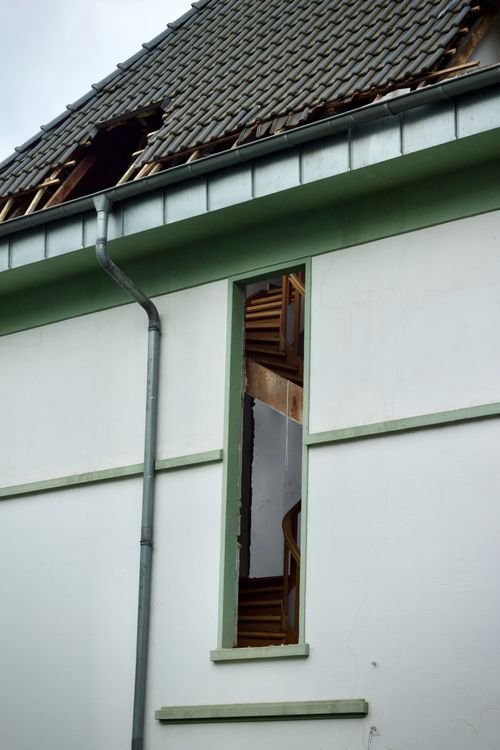
Roof Insurance Claim Process Texas — the 7 Steps
Follow these seven steps in order for any roof insurance claim Texas homeowners file after hail or wind. The step most homeowners skip — the free professional inspection before the adjuster — is the one that matters most. The roof insurance claim process Texas follows has the same seven steps whether your roof is in Lubbock or League City — the order matters more than the speed.
Document the damage yourself
Photograph the roof from the ground, dented gutters, damaged screens, AC fins, and any water inside. Note the storm date and time. Save any hail report or weather alert.
Stop the water
Tarp the roof, cover openings, move belongings. Your policy requires you to prevent further damage. Keep every receipt for emergency work — tarping is generally part of a covered claim.
Get a free professional inspection — before the adjuster
A roofer inspects the roof, takes dated photos, marks test squares, and gives you a written report and a written scope and price. You now know what the damage is before anyone from the insurance company looks at it.
File the claim promptly
Call your insurer or file online. Give them the storm date, a description of the damage, and the inspection report if you have it. Policies require prompt notice, and waiting months weakens a claim — hail evidence fades.
The adjuster visit
The adjuster inspects the roof and writes a scope — a line-by-line list of what will be paid for. You can, and should, have your roofer present. The roofer can point out damage the adjuster might miss and discuss scope items like flashing, decking, and ventilation.
Review the scope line by line
When the adjuster’s estimate arrives, compare it with the roofer’s scope. Are all damaged slopes included? Is the decking allowance realistic? Is flashing, drip edge, and ventilation included? Is the deductible calculated correctly? If something is missing, ask for a supplement — an additional payment for items the first estimate missed. Supplements are normal, not adversarial.
Approve and schedule
Once the scope is agreed, sign the contract, pay your deductible as the work progresses, and schedule the work. After completion, send the final invoice and photos to the insurer to release recoverable depreciation.
Deadlines your insurer has to meet
Texas law puts your insurer on a clock too — Insurance Code Chapter 542, the prompt-payment law — and knowing the deadlines is part of filing a roof insurance claim Texas with confidence, rather than waiting and wondering. Those deadlines apply to every roof insurance claim Texas homeowners file. Texas roof insurance claims are governed by the same prompt-payment law — your insurer cannot sit on a claim once it has what it asked for.
After it has everything it asked for, it has 15 business days to accept or reject the claim in writing — a rejection must state its reasons (§542.056). Once it accepts, it has 5 business days to pay (§542.057). If the insurer misses those deadlines, §542.060 provides for statutory interest plus attorney’s fees. Knowing the clock exists is useful; you should not need a lawyer to make it run — a polite, dated, written reminder that cites the deadline usually does it.
How long does the whole claim take? A clean hail or wind claim typically runs 60 to 120 days from storm to final payment; a contested claim can run six months or more, and catastrophe claims after a major event have run nine months because there are not enough adjusters in the state. If you want to know how to get insurance to pay for roof replacement Texas adjusters require, the answer is documentation: dated photos, the storm date and a written scope.

FAQs
How long do I have to file a roof claim in Texas?
Your policy requires prompt notice for a roof insurance claim Texas — in practice, days or weeks, not months. Many Texas policies now also carry a hail endorsement that requires you to report the loss within one year of the storm date. Filing within the first 30 days gives the best outcome: the evidence is fresh and the insurer cannot question the cause. Texas law also sets a general two-year window for property damage claims, but waiting weakens your case, because hail evidence fades and the insurer can question the cause. Do not rely on the old “you have two years” advice: recent legislative sessions have tightened filing windows for first-party property claims. File promptly, and confirm the current deadline for your specific loss date with TDI or a licensed Texas public adjuster.
Will filing a claim raise my premiums?
Possibly, but a single weather-related claim is treated differently from a negligence claim, and Texas law limits how insurers can use weather claims. The deductible math — whether the claim is worth more than your deductible — is the first question to answer before you file a roof insurance claim Texas.
Should I file a claim if the damage costs less than my deductible?
Usually not. If the repair costs less than your deductible, the insurer pays nothing — and the claim still goes on your claims record, where future insurers can see it. Pay for small repairs yourself and save the claim for damage that is clearly above your deductible. If you are not sure what the repair costs, get the free inspection first: a written scope tells you the number before you decide.
Can my insurer refuse to renew my policy because my roof is old?
Not on age alone. The Texas Department of Insurance clarified on September 29, 2026 that insurance companies cannot decline or refuse to renew a home policy based solely on a house’s age or roof age. That does not mean an insurer must cover a roof in poor condition — it means age by itself is not a reason to drop you. If a renewal letter cites roof age, ask the insurer for the specific underwriting reason in writing and check it with the Texas Department of Insurance.
Can my roofer talk to the adjuster for me?
Your roofer can be present at the adjuster meeting, point out damage, and discuss scope. Your roofer cannot negotiate the settlement on your behalf or act as your legal representative unless they are also a licensed public adjuster. Texas law (Insurance Code §4102.163) bars a contractor from acting as a public insurance adjuster — or negotiating your claim — on a property where they are doing the contracting work. TDI Bulletin B-0008-24 draws the same line. If you want someone to negotiate for you, that is a licensed public adjuster — you can verify a licence through the Texas Department of Insurance. Insurance for roofing contractors Texas homeowners should check before hiring is simple — ask for the roofer’s liability and workers’ compensation certificates, in writing.
Do I get an insurance discount for a Class 4 roof?
TDI Bulletin B-0008-26 (September 16, 2026) says insurers must give real discounts for Class 4 impact-resistant and FORTIFIED roofs, and must not re-inspect a certified home. It is not a mandate, and it states no fixed percentage: typical discounts run 10–30%, and a Class 4 upgrade costs around $50 per square extra. Ask your insurer what discount a Class 4 roof earns on your policy before you replace your roof.
What if I disagree with the adjuster’s number — is there a formal way to challenge it?
Yes — appraisal. Most Texas homeowners policies carry an appraisal clause, and since January 1, 2026 a binding appraisal provision is required in residential policies delivered, issued or renewed on or after that date (SB 458, Texas Insurance Code Chapter 1813). Appraisal settles one question only: what the loss costs. It never decides coverage — if your insurer denies the claim outright and says there is no covered loss, that is a coverage dispute and appraisal cannot settle it. Only you or your insurer can demand appraisal, and the demand must be in writing — a roofer cannot invoke it for you. TDI has proposed a rule (28 TAC §5.9805) setting the deadlines, including a one-year window from the insurer’s notice accepting or rejecting the claim, but that rule is not final yet — if your policy renewed earlier, your own policy’s deadlines apply.
What is the average deductible for roof replacement in Texas?
Most Texas homeowners pay a percentage deductible — 1% or 2% of the Coverage A limit — so the average deductible for roof replacement in Texas is $3,000–$6,000 on a $300,000 home, per the table above. Check your policy’s wind/hail percentage before the adjuster arrives.
Can I still get a 1% wind/hail deductible in Texas?
On a standard policy, some carriers still offer 1% — but the floor is rising. The Texas FAIR Plan, the state’s insurer of last resort, eliminated its 1% wind/hail deductible option on policies effective July 1, 2026: its wind/hail options are now 2%, 3%, 4% or 5%, and existing 1% policies move to 2% at renewal. Across the Texas market, 2% has become the common floor in the hail belt, and many insurers move customers from 1% to 2% at renewal. Whatever your percentage, it is calculated on your Coverage A limit, not on the claim — check your declarations page before the next storm.
This page is education, not legal advice, about a roof insurance claim Texas. For policy-specific questions, contact your insurer or the Texas Department of Insurance. We serve Lubbock, Wolfforth, Shallowater, Levelland, Slaton, Idalou, Abernathy, New Deal, Ransom Canyon, Brownfield, and Lamesa. A roof insurance claim Texas families rely on us to document starts with a free inspection — dated photos and a written price.
Get Your Free Inspection First
Call or text (806) 419-8209 for the fastest answer. If a storm has hit your roof, do not start your roof insurance claim Texas with a phone call to your insurer. Start with a free inspection with dated photos and a written price — so you know what the damage is, what it costs to fix, and whether a claim makes sense, before anyone else looks at the roof.
Related pages: Hail & Wind Damage Repair · Lubbock Hail Season Guide · Roof Inspection · Emergency Roof Repair · Roof Replacement · Roof Cost Calculator